Monday, 6 May 2013

Disability and Self Employment UK Part 1


If you are living in the UK and claiming disability benefits, you might have heard of Permitted Work. This is a scheme which allows disabled people claiming certain benefits to try out employment for up to 16 hours per week and earn no more than £99.50 without it affecting any benefits. As most people know, the rules for claiming benefits, the rates and types of benefits are constantly changing, especially at the moment as the government works towards the Universal Credit system. This website has some good info about which benefits qualify for Permitted Work and has some up to date information about it:


For a lot of disabled people even a small amount of work outside the home is at best impractical, and for others impossible. Working from home with flexible hours would be a welcome opportunity for many, but the help to find it isn’t exactly abundant. Self-Employment is risky, but with Permitted Work it is a viable option.

I’ve recently started Permitted Work, but it took a long time because it wasn’t very easy to find anyone who knew much about trying Self Employment with it or how it worked. In fact a lot of people didn’t know you could try Self Employment with it and thought it was a mistake or I was confusing it with the New Enterprise Scheme.

If you’re like me, you want to know as much as possible beforehand, it’s frustrating thinking you know something only to come across another hurdle at every stage; forewarned is forearmed and all that.

Although the rules for Permitted Work and the different benefits all seem to be the same, my personal experience is of Employment Support Allowance and Permitted work. I can’t claim to know for definite how it works for other benefits, especially those where claimants have other sources of income, and filing tax will be a bit different.  Also, each small business will be different and you might need start up loans and have large expenses, so please just use this as a guide.


Getting Started
 

To apply for Permitted Work, you have to fill in a very simple form called the PW1 form. You can get this from the Job Centre or your personal adviser. This link goes to a PDF image of the form. The form is worded more for people trying employment but basically just asks for your personal info; if it will be self-employment; the name and address of the employer or company (you); job title; brief description of duties; when the job begins; how much you will earn; how many hours you’ll work each week and whether this varies; and when you will get your first payment.

Make sure you put the current permitted wage limit (£99.50 per week at the moment), and that you will be working less than 16 hours.

Send the form in at least 4 to 6 weeks before you want to start trading. Put this date on the form where it asks what date the job will begin.

Enclose a business plan or a detailed description of what the business will be and how you want it to grow. Business Link can send you some really good PDFs about how to plan for your business and write a business plan.  https://www.gov.uk/business-support-helpline

And the Business Link website has some good advice: https://www.gov.uk/browse/business/setting-up

Open a business bank account. If you want to do online banking this could take a few weeks to set up because of safety measures. If you will be selling online/accepting payments online, tell the bank this and ask for a debit card so you can set up a business PayPal account. You might have to regularly deposit small amounts of money into the business bank account to keep it ‘active’ until you start trading. Remember to keep a record of this.

Phone the Benefits Agency on or around the date you said you wanted to start to see if you’ve been accepted. I didn’t receive a letter telling me I had, I don’t know if this is standard or an oversight.

If you have been accepted, ask the Benefits Agency to submit a PW10 form to HMRC.

Go online to register for Self-Assessment with HMRC. You will get registration numbers, a government gateway account number and then through the post, an activation code. This will take a few weeks so keep a record of all numbers and passwords etc. so you don’t lose or forget them.

Writing a business plan

There is no set way to write a business plan, but remember it is as much for you as for anyone else you need to send it to. You can always do alternate versions, for example a more detailed one if you need to apply for financing, and a simpler one to send with your PW1 form.
Here is an example of a Business Plan, and what each of the sections requires.  


In my next post I will talk about keeping accounts.
 

Saturday, 4 May 2013

Collage Sheets

I've been working on a few more designs for collage sheets to sell on etsy. I already have a few on there, but haven't sold any yet. I thought I'd upload a few sample sheets for anyone who'd like to try them, and hopefully get some feedback. All the images are derived from my own original artwork: oil, acrylic, gouache and watercolour paintings; pastels; glass paintings; digital designs and patterns and digitally altered versions of original artwork. All the images are high quality 300 dpi resolution. Two of the collage sheets feature 9 ATC sized images (3.5 x 2.5 inches). This is a sample of the first one:
You can download the full sized original here.
This is the second ATC sample sheet:


You can download the full sized original here.
This third sheet features smaller images, these tile sized images are  9.08 x 5.08 cm or 3.57 x 2 inches each. There's also a border strip sample too.


You can download the full sized original here.
The last sheet features small tiles, 3.81 x 1.91 or 1.5 x 0.75 inches, suitable for using on bamboo tiles.


You can download the full sized original here.

Feel free to download and print and use in your artwork, all I ask is that my copyright is respected and that the images aren't sold, nor distributed on a large scale, either as a digital file, on a CD/DVD or as prints of the whole sheet or images as is. It'd be nice to get credit if any of the images are used and I'd really love to see anything that is made using them, and get your feedback :)


Wednesday, 1 May 2013

Sewing and Experimenting

I've been trying to continue with the things I learned during Ruth's challenge for getting 5 minutes of fibre time into each day. I don't always manage that and often end up with one or two days where I have a couple of hours fibre time, and 3 or 4 days without, but I'm organising my time better and having projects at different stages, ready to work on when I do have the time. On my desk I have a box of  felt pieces that have been measured and cut and are waiting to be sewn. I also have a box of part made up items; things like purses, glasses cases and coin pouches which have been sewn on the machine and are waiting for me to finish off with blanket stitch. These are a few of the purses at various stages, the blue ones just have the back pocket mahchine stitched into place, the white piece on the left has some stitching around the pocket edges, and the one at the front is just in need of a button and buttonhole.


This is one of the camera cases I've been working on. The gray fibre is carded silk carrier rods. I blended some of the silk 'fluff' with merino and used some for surface texture.


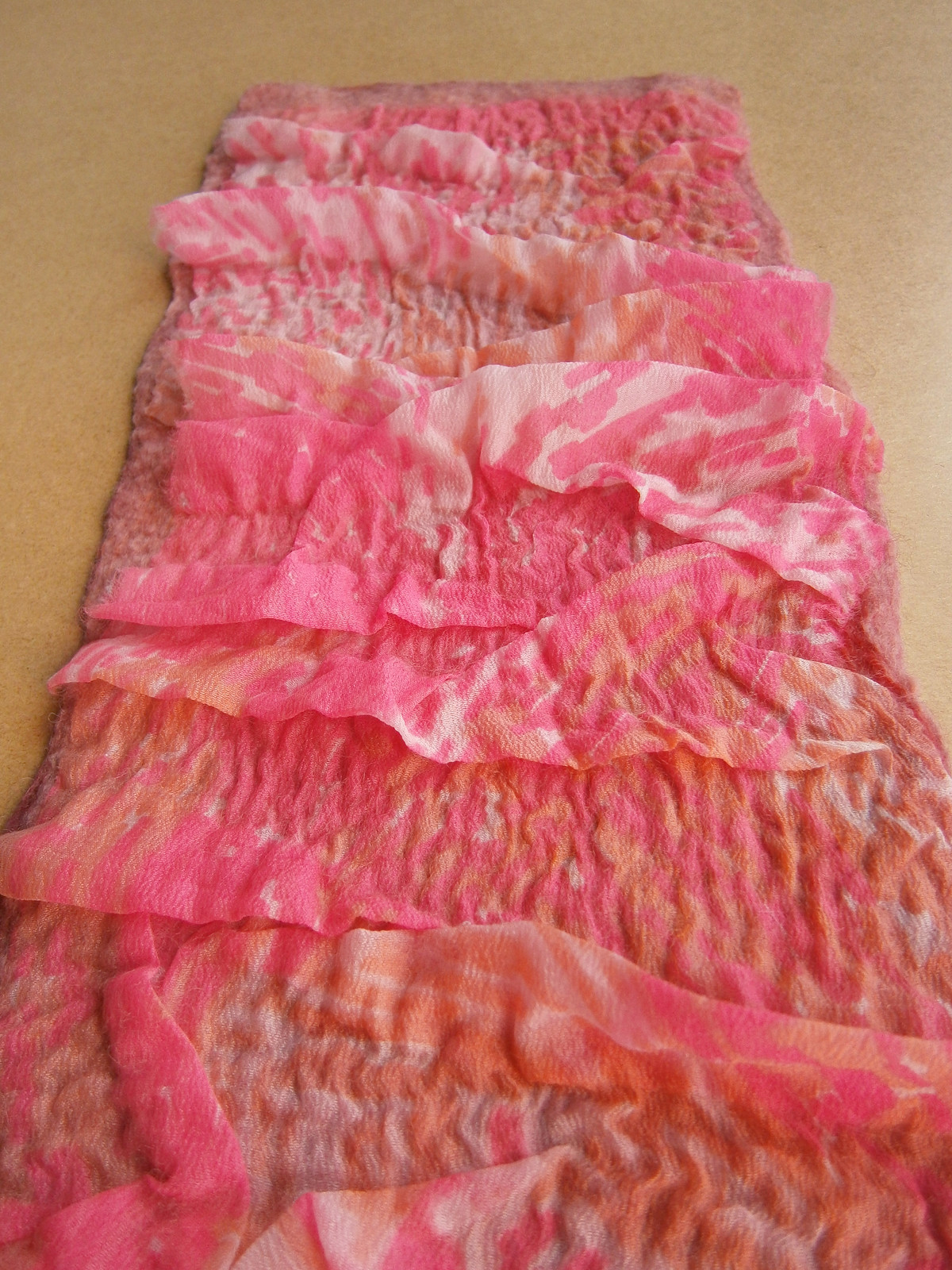
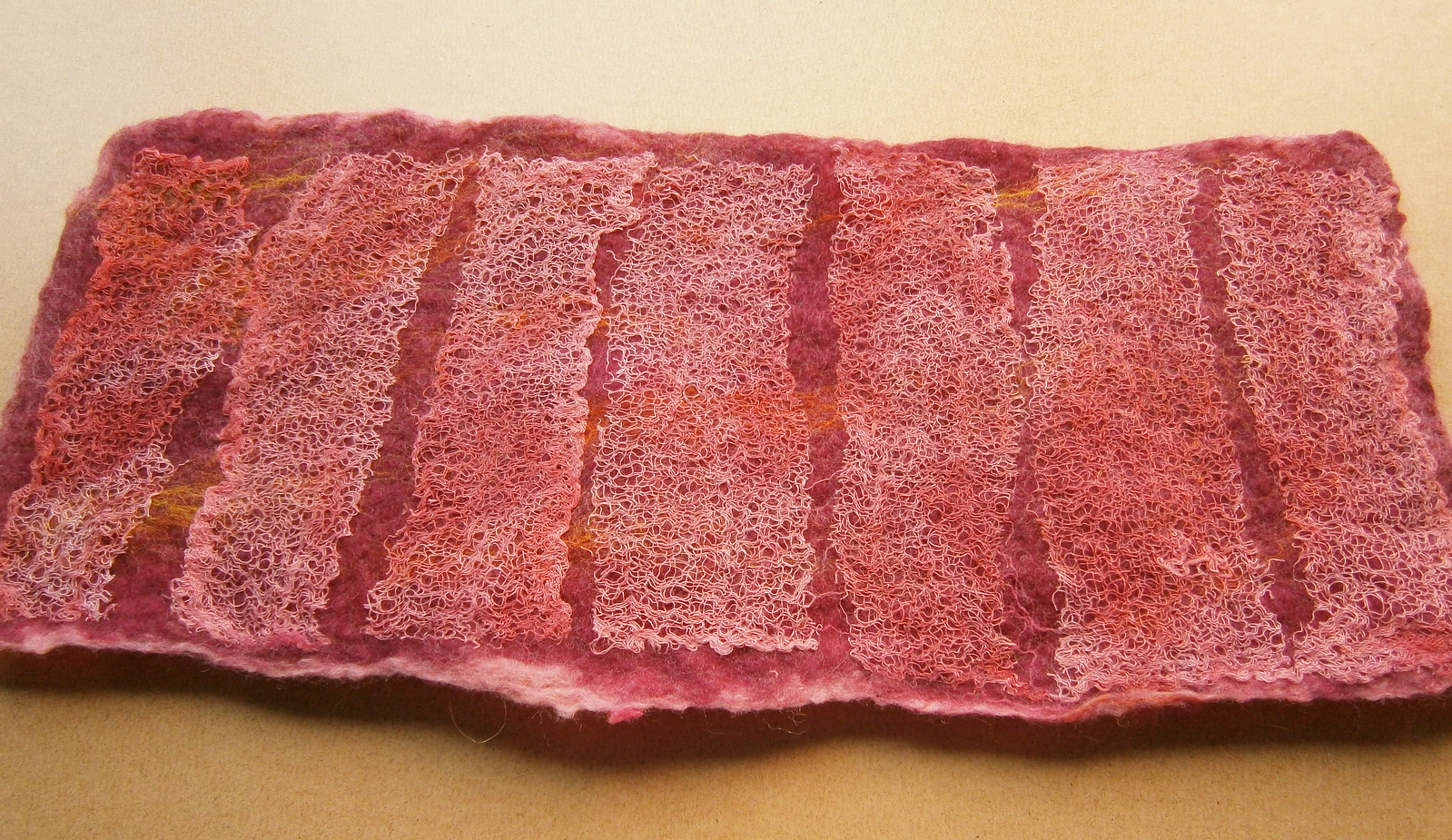
I mentioned on a previous post that I had one more felted piece using the pink synthetic fabric. It isn't really meant to be anything but an experimental piece, combining nuno techniques and using a resist. This is a compilation of images.


Another experimental piece I did was one using some crimped acrylic fibre that looks like a synthetic version of laps.


It produced a really nice effect.


I have managed to finish off a few pieces and must get them photographed for listing on etsy. This ring pouch is one piece I finished. I first made some heart ring pouches a few years ago so I had somewhere safe to put my rings and bracelets when I take them off for felting. I've made a few more for gifts. They're only small, about 2 inches high and 2.5 inches wide, this photo makes this one look huge!


Sunday, 28 April 2013

Inexpensive Fabrics

Quite a few of the visitors to my blog and the Felting and Fiber Studio Site are students doing textile courses such as those offered by City and Guilds. I know that supplies can be very expensive, especially when you have to buy a lot of them for course work. I use quite a lot of fabrics in my felt work, both for nuno felting and for using as lining fabrics. I also buy lots of fabrics just because they're gorgeous :) The main place I get my fabric supplies is Abakhan, and the majority of fabrics in Beyond Nuno (apart from the silk) were bought from there. If you're in the UK, especially the North West England, you might have heard of them. There are 8 stores in the UK: Birkenhead, Chester, Hanley, Liverpool, Mostyn, Preston and Bolton. They also have some stores in Estonia and Latvia.


On Thursday I went to the shop in Manchester. Luckily, the Post Office I went to beforehand had shut down, and I didn't have much money on me, so I stuck to what was on my list and just got a few extras :) The Manchester branch has pretty much everything I need; apart from the fabrics, I get my DMC thread from there, sewing machine thread, zips, bag fasteners, clasps, bobbins. They have items for all kinds of crafts, scrapbooking, cardmaking, handles for handbags, purse clasps, knitting and crocheting supplies and more dyes than I knew existed :) If you look on the website at the list of stores, it gives you a list of products available in each store.


In Manchester at the shop on Oldham Street, they have a selection of fabrics on the roll, bolts of fabric and a massive selection of remnants sold by weight, though these aren't 'scraps' or small pieces, they are all at least 1 metre in length. I only had organza and DMC threads on my list the other day and I got a gorgeous selection of organza colours off the roll, I also got some gorgeous organdy. The golden piece next to the copper cost me 64p! I can't wait to use it.


I did buy a couple of things that weren't on my list, but they caught my eye and weren't huge pieces. They are both georgette fabric, this one was the biggest piece and cost about £2.30.


And this gorgeous patterned piece cost £1.80:


If you have a store near you, it really is worth going in to see what they offer. Just don't be surprised if you end up with enough fabric to re-upholster your couch and make new curtains for every room :)  I remember going for a family day out about 20 years ago to the store in Mostyn, and I noticed on their website that if you're planning a group visit to Mostyn, there are lots of offers and discounts available. If you don't have a store near you, the website has lots of great things to offer and postage prices are one standard delivery charge depending where in the UK you are. Have a look and hopefully save yourself some money :)

If anyone knows of any other great fabric stores, please feel free to mention them in the comments :)

Friday, 26 April 2013

Pink!

 I did try to post this yesterday, but Blogger won't let me upload pics from my computer to add to the post, I hade to use Flickr URLs and Picassa. Is anyone else having problems?

On my last post I showed you a sneaky peek of the ripples and ruffles of the nuno felted piece I made for Ann's challenge on The Felting and Fiber Studio site. Well, here's the finished piece in full:


Here it is from another angle:


It's kind of double-nuno because I started with some pieces of cotton gauze that I'd dyed a while ago. I wanted it to be extra sturdy to make a camera case out of it:


I really liked how it turned out, so I thought I'd make a similar piece. I measured this one carefully to make a book cover out of it. I also added some wisps of orange, beige and white to the merino at each end to match the patterns and colours of the fabric.


You can see the texture more from this angle:


And of course, a supermacro close up :)


I have just one more piece I made from this fabric, but it is still drying. If you're interested in learning more about felting with synthetic fabrics, nuno felting in general or the techniques I used, please have a look at the info about my e-book, Beyond Nuno here, thanks :)