Showing posts with label embellishment fibres. Show all posts

Saturday, 30 March 2019

Feb/March Review: Unusual Embellishments

I mentioned at the end of my look back at January, that February had been all about unusual embellishments. That carried on into March too, but I'll stick with the theme and show them altogether. Using unusual embellishments isn't really unusual for me, but I think I might have a bit of a surprise near the end :) It started in November when my friend had some shiny hair decorations/extensions that she was removing and throwing away, so I asked if I could 'scav' (scavenge) them out of the bin to try felting with. They originally come straight, but after being plaited/braided, end up wavy/kinked. I decided to try them with a wool blend which came in some Botany Lap Waste from World of Wool. It is really soft, greyish and has the odd bit of Angelina blended in. I couldn't see any in what I used though:


From this angle you can see better how they attached:
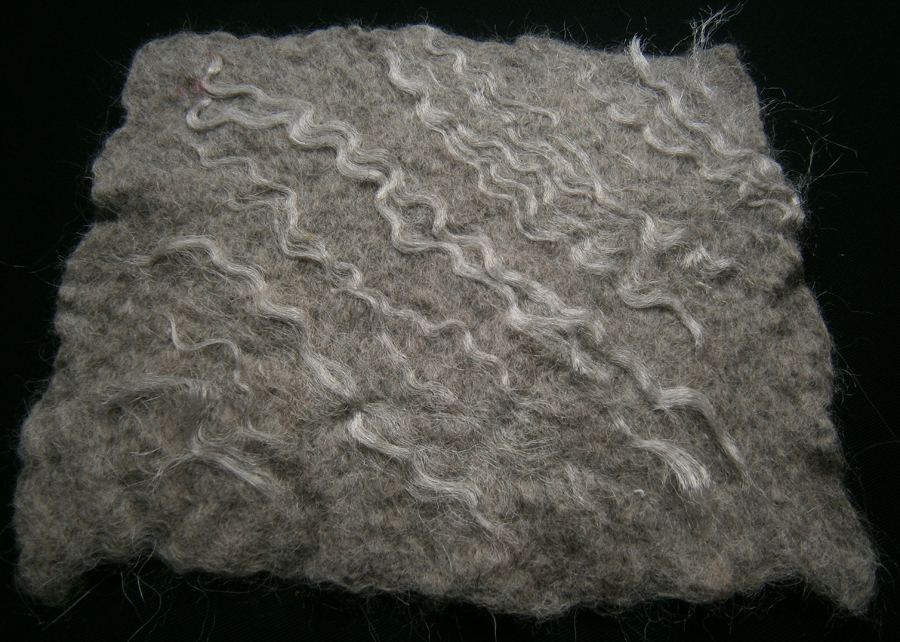

Thicker pieces of the fibre kept their shape and were more prominent, and where it was thinner/spread out, they blended in more:


The next time my friend used the extensions, she saved them for me when she removed them. They were really nice colours:


I blended up some Merino to match:


I used the same wool blends twice, and I started by matching the fibres to the blends:


But used different coloured fibres on top at the other end (not great photos)


As soon as I started to wet it down it felt like there were far too many fibres on top. They kind of look/feel like trilobal nylon, but not quite as fine. It took a lot to get it felted, the fibres acted like a barrier between my hands and the wool, I had to rub mostly from the back. I even resorted to rolling the felt in a bamboo mat. This is how it looked when it was dry:


You can see how much of the fibre is loose:


I tugged off lots of loose fibre and this is how it looked afterwards:


It looked like I pulled it all off, but it was more obvious looking on an angle:


And I had to get a supermacro close up!


I used the same hair extensions again. This is how the finished piece looked:


I twisted some of it around some wool twists I'd previously made, spun some with some white pencil roving, fluffed some up and made a kind of 'ball' out of it, blended some with Merino, and used a couple of pieces which were still partly plaited/braided. The two biggest patches on the bottom of this angled photo are, on the left, the loose ball, and in the centre, the blend with wool:


This is a closer angled pic:


This is one of the partly plaited pieces:


I undid the ends of this one, sorry, not the best photo:


This next pic is a small amount spun with pencil roving on a drop spindle. I just twisted it, then used it so it's loose:


I did my last experiment with unusual fibres a couple of weeks ago. Unfortunately I didn't get lots of great photos, but this is what I tried out:


And this is one of the locks:


I used 23mic natural white Merino, and this is the finished sample:


This is a close up of the top left where I fluffed up the fibres:


And this is how the migration looked on the back:
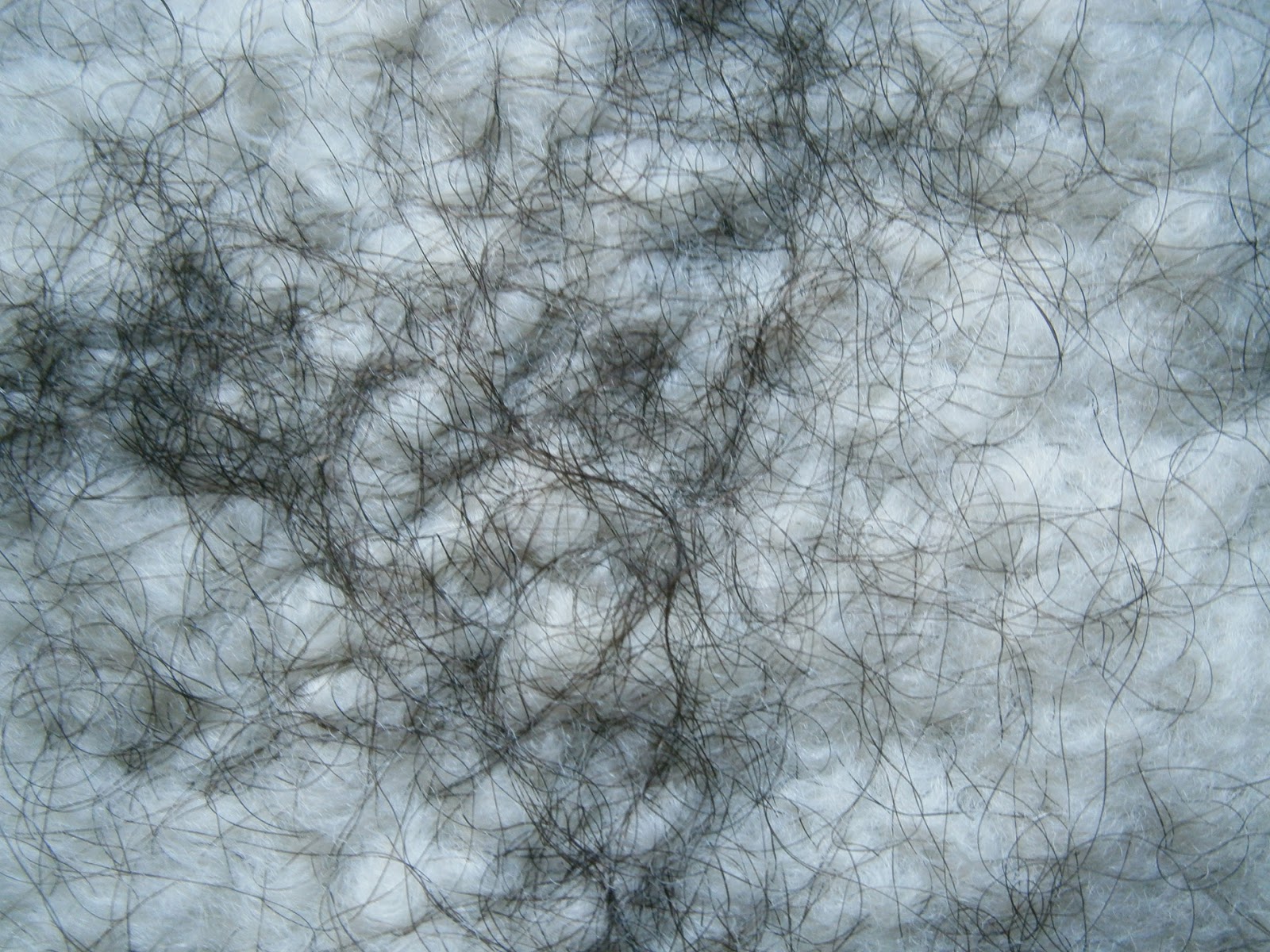

 This is one of the felted locks, it is attached at the base, and springs loose:


Sorry there aren't more/better photos, but did you guess what the fibre is? It's my friend's hair who gave me the extensions! I clippered it for her a couple of weeks ago and decided to see how it felted :)
What's the most unusual fibre you've ever tried?

Tuesday, 12 September 2017

Testing the Limits of Fibres

I was tidying away some felt recently and remembered that I'd planned to make some felt pieces like the textured nuno pieces I made, but with different fibres instead of fabric. I've tried 'piling on' embellishment fibres in the hope of getting a fluffy effect or loosely attached/3D look a few times, but apart from a really slippy/slinky feeling acrylic fibre, and some weird fibre/wool combos (Suffolk wool and banana fibre springs to mind) they've all just stayed put and attached well. Since I mostly use Merino for 'everyday' pieces, I wanted to see how a couple of layers of different fibres attached, and also what effect I'd get from some hard fulling.

I laid out a couple of pieces the same way, but different sizes. I laid out two layers of dyed viscose fibre, then 4 fine layers of 23 mic Merino. I felted and fulled the first piece, then got my bead board out to full it more. I fulled until it was quite firm, but not stiff/rigid:


I got the texture I expected:


I didn't expect so much migration, probably because the soft/fine pieces I've fulled really hard with fibres before were using white 18.5mic Merino, and I used less fibre, I thought it'd be less obvious this time:


I changed my plans when I got to the felted stage of the first piece, it looked and felt so nice. So, I decided I would just felt the next piece 'normally'. Even if I hadn't already decided that, I don't think I could have 'ruined' this piece by fulling it lots:


The colours and the sheen are just gorgeous, so is the softness and drap, even though it's only a small sample:


Those ridges/crinkles are because I squeezed it in a towel, then hung on the line to dry! If you look at the blue parts you might see a crease along the edge too, it's such a light piece, the pegs weighed it down and bent it. Here's a close up:


You can see the differences in sheen and texture when the pieces are next to each other:


This is the soft piece on the template I used, it started out just a bit bigger than the small box it's on top of:


And the small piece started out the size of the largest outline on the template:


And yep, those are the same template!

I made a few more fibre samples. I thought I'd use the same template for all of them to do comparisons. In the end, I only did a 'normal' sample and a 'fulled hard' sample of Trilobal Nylon for a direct comparison. Though thinking about it, for a 'proper' comparison, I should really have used the same colours! Each sample has two layers of the fibre, and 4 thin layers of 23 mic Merino. This is the Trilobal Nylon sample which I felted and fulled in the way I usually do:


Here's a close up of the ripples/texture:


This is the Trilobal nylon sample I made and fulled hard:


The texture was interesting, especially where I used different colours for each fibre layer:


This next one is Soy top which I dyed, the tops all look nice, shiny, metallic shades, but for some reason, they now look a bit like wet tissue. Maybe two layers dulls the sheen?


The silver end looked quite nice:


My favourite piece out of these was the Nylon Staple sample. It had a really nice, thick texture:


You can see it a bit more on an angle:


At first I was a bit disappointed with all the migration, because it covered some areas:


But, then I noticed there was something quite regular, almost geometric about the migration:


It can always be disguised by using a matching colour, or made a feature of by using a complementary colour. Here is a photo of the nylon and soy pieces next to each other:


And, for reference, the bigger Trilobal Nylon sample on the template I used:


So, you can see, you don't need to cautiously anchor down a few strands of fibre with wisps of wool! I used quite a lot of fibre on each sample. The nylon staple is one which intrigues me the most because I love texture and it has me thinking of ways to use it, but the Viscose top is gorgeous, so vibrant and shiny!

If you're curious about using embellishment fibres in wet felting, but don't know where to start, have a look at the info page for my e-book, The Right Fibre: https://feltbyzed.blogspot.co.uk/p/the-right-fibre.html

Sunday, 5 April 2015

Karakul

I was hoping to get some time for felting yesterday, but I had vertigo and felt rotten so I'm posting some pieces I made a few weeks ago. I got two different Karakul batts from wollknoll, one is just Karakul and the other is a Karakul and Merino blend. Just be warned if you google Karakul, you'll probably get some pretty awful photos of dead lambs because their skin is used to make hats and coats because their wool is black and silky soft when they are born, and they don't often make it that far so there's quite a few photos of dead sheep too. This wool is sheared the usual way though. It is double coated and very wiry, it reminds me a lot of a Cairn Terrier my friend had when we were kids:


I used some dyed silvery flax with the Karakul, spreading it thinly across the top and bottom, and laid it  vertically in the centre:


It looked like it was just sitting on the surface:


The contrast of the 'dry' looking Karakul and shiny flax, made the flax look like it was still wet:


The Karakul and Merino looked and felted similarly, though less 'openly' or loosely and was a lighter shade:


Both of the batts had bits of VM in which looked like porridge oats or tiny cornflakes. A few of the batts I got had similar VM:


I used some crimped Viscose fibre with this:


This is some Viscose which wasn't teased apart much:


This is a patch where the Viscose was teased apart a lot and laid on quite thickly:


And this is where the teased out Viscose was laid quite sparsely: