Showing posts with label felting fibres. Show all posts

Tuesday, 12 September 2017

Testing the Limits of Fibres

I was tidying away some felt recently and remembered that I'd planned to make some felt pieces like the textured nuno pieces I made, but with different fibres instead of fabric. I've tried 'piling on' embellishment fibres in the hope of getting a fluffy effect or loosely attached/3D look a few times, but apart from a really slippy/slinky feeling acrylic fibre, and some weird fibre/wool combos (Suffolk wool and banana fibre springs to mind) they've all just stayed put and attached well. Since I mostly use Merino for 'everyday' pieces, I wanted to see how a couple of layers of different fibres attached, and also what effect I'd get from some hard fulling.

I laid out a couple of pieces the same way, but different sizes. I laid out two layers of dyed viscose fibre, then 4 fine layers of 23 mic Merino. I felted and fulled the first piece, then got my bead board out to full it more. I fulled until it was quite firm, but not stiff/rigid:


I got the texture I expected:


I didn't expect so much migration, probably because the soft/fine pieces I've fulled really hard with fibres before were using white 18.5mic Merino, and I used less fibre, I thought it'd be less obvious this time:


I changed my plans when I got to the felted stage of the first piece, it looked and felt so nice. So, I decided I would just felt the next piece 'normally'. Even if I hadn't already decided that, I don't think I could have 'ruined' this piece by fulling it lots:


The colours and the sheen are just gorgeous, so is the softness and drap, even though it's only a small sample:


Those ridges/crinkles are because I squeezed it in a towel, then hung on the line to dry! If you look at the blue parts you might see a crease along the edge too, it's such a light piece, the pegs weighed it down and bent it. Here's a close up:


You can see the differences in sheen and texture when the pieces are next to each other:


This is the soft piece on the template I used, it started out just a bit bigger than the small box it's on top of:


And the small piece started out the size of the largest outline on the template:


And yep, those are the same template!

I made a few more fibre samples. I thought I'd use the same template for all of them to do comparisons. In the end, I only did a 'normal' sample and a 'fulled hard' sample of Trilobal Nylon for a direct comparison. Though thinking about it, for a 'proper' comparison, I should really have used the same colours! Each sample has two layers of the fibre, and 4 thin layers of 23 mic Merino. This is the Trilobal Nylon sample which I felted and fulled in the way I usually do:


Here's a close up of the ripples/texture:


This is the Trilobal nylon sample I made and fulled hard:


The texture was interesting, especially where I used different colours for each fibre layer:


This next one is Soy top which I dyed, the tops all look nice, shiny, metallic shades, but for some reason, they now look a bit like wet tissue. Maybe two layers dulls the sheen?


The silver end looked quite nice:


My favourite piece out of these was the Nylon Staple sample. It had a really nice, thick texture:


You can see it a bit more on an angle:


At first I was a bit disappointed with all the migration, because it covered some areas:


But, then I noticed there was something quite regular, almost geometric about the migration:


It can always be disguised by using a matching colour, or made a feature of by using a complementary colour. Here is a photo of the nylon and soy pieces next to each other:


And, for reference, the bigger Trilobal Nylon sample on the template I used:


So, you can see, you don't need to cautiously anchor down a few strands of fibre with wisps of wool! I used quite a lot of fibre on each sample. The nylon staple is one which intrigues me the most because I love texture and it has me thinking of ways to use it, but the Viscose top is gorgeous, so vibrant and shiny!

If you're curious about using embellishment fibres in wet felting, but don't know where to start, have a look at the info page for my e-book, The Right Fibre: https://feltbyzed.blogspot.co.uk/p/the-right-fibre.html

Saturday, 11 July 2015

Dyeing

I've been dyeing some cellulose fibres recently for taking to the MakeFest at the Science and Industry Museum in Manchester. I'm getting the hang of it now, but I don't think my first lot of fibres turned out as nice as I'd like. I did some Viscose fibre recently, and this turned out really nice. These are some of the reds, oranges and yellows:


And some yellows, greens, blues and purples:


I don't like the way dyeing cellulose fibres wastes so much water with the rinsing, but it is easier for me to do large amounts than it is with acid dyes, not that I had much choice, even mixing up just 500ml each of red, yellow, blue and black was more than enough to dye about 200g of fibre and I had to look for other things to dye so as not to waste it :) I tried dyeing Kapok fibre too, that stuff is practically impossible to wet, it seems to form a 'skin' around itself, so dyeing gave some interesting results as it behaved the same way, and when the fibre was separated, the centre wasn't dyed. This is some rose and lilac coloured kapok:


I've mostly stuck to dyeing staple fibres. I also had bamboo staple fibre. These are the greens, blues, purples, silver and black shades I dyed:


And here are the yellows, browns and reds bamboo staple:


I tried out some tops of rose fibre, the photos didn't come out, but the tops dyed well so I dyed some bamboo top:


They came out really nice, so I used up the last of the blue and purple dyes on some viscose top:


And since I'd already made a mess in the kitchen and hadn't got around to putting the table/equipment away, I started dyeing with acid dyes. Only these silk carrier rods were dry enough to photograph:


I'm not going to dye all the fibres I'm taking, I wanted the fibres to be easily recognisable as the same as the samples they have in the Textiles Gallery, showing where fibres come from and the fabric they're made into, but I wanted to show/offer dyed samples too.

Tuesday, 15 October 2013

New Drum Carder

At least once a year I've contemplated buying myself a drum carder. But after seeing the wool blends Ann from the Felting and Fiber Studio carded a few weeks ago, I seriously considered it, and after looking at a link Judith gave me to ebay, I bought myself a gorgeous handmade Ash drum carder from the Classic Carder company. I wasn't very good on my first few tries, but I soon got the hang of it :)


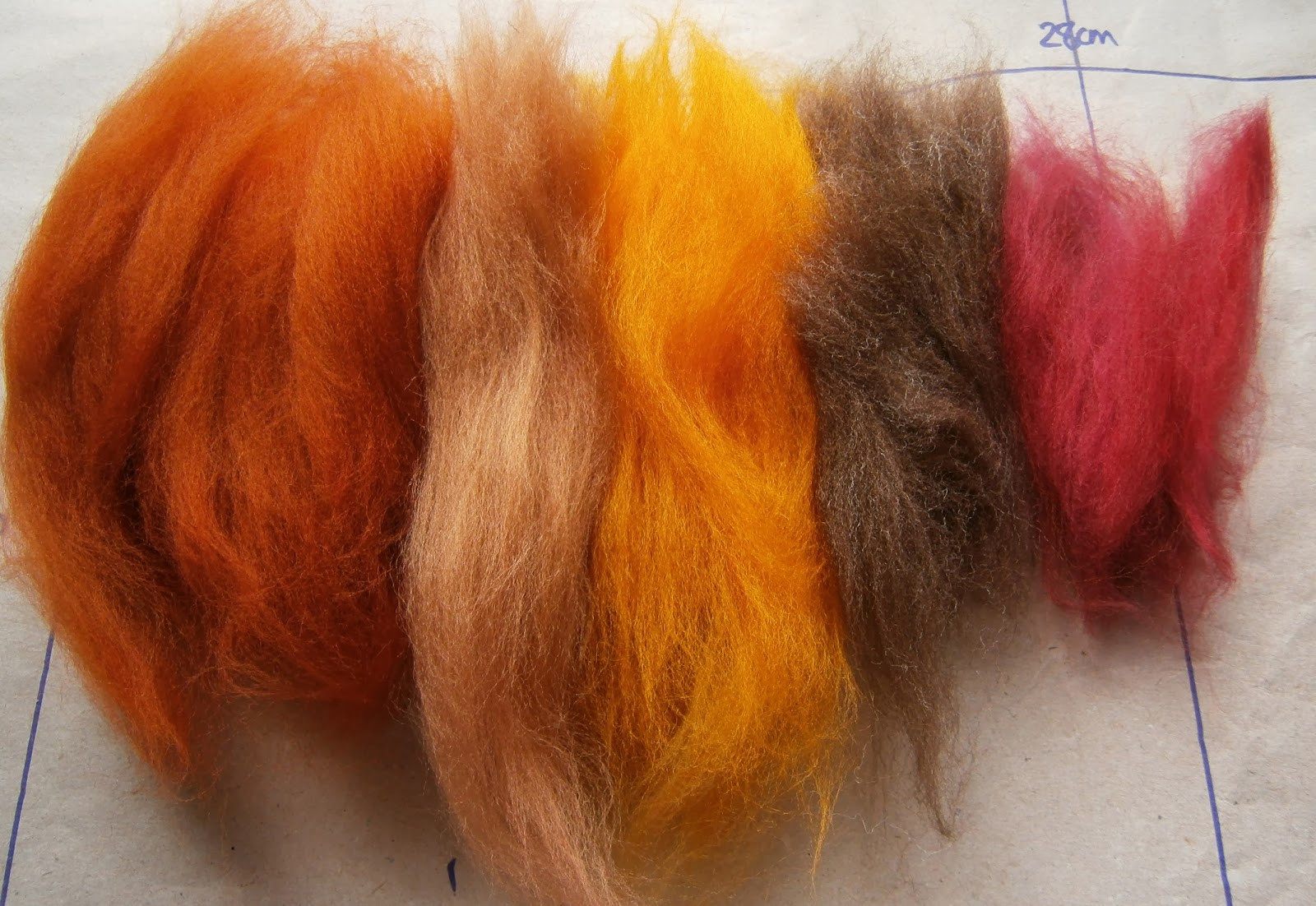
I thought I should have an 'aim' instead of just going mad and making lots of nice coloured batts, so I decided to  work out roughly how much wool I'd need for one layer if I'm making a piece of felt big enough to make a cover for an A6 notebook. I got my template out, chose a coppery bronze colour theme and then laid out the different coloured wools in different proportions.


I then gathered all the colours up, weighed them and kept notes. I'd usually think to do this after the fifth time of laying out colours, so I'm impressed with myself :)


I added some small amounts of flax and soy top to a couple of the lighter colours, and it's not obvious from the photo, but I added black bamboo to the natural brown merino.


I was impressed with how it looked after just one turn through the carder, but I wanted it more subtle than it had turned out, so I put the wool through again. I really like how it turned out the second time.


I've been thinking for a long time about making up 'experimental' or 'inspiration' fibre packs to sell on etsy. Working out what to put in there to make it worthwhile with our postage prices was difficult, but Marilyn recently suggested selling wool aswell to make it more of a kit. I had a think about how to do it and came up with the idea of including just enough wool to do one layer, a nice blend for the top. I thought this batt would be perfect for the first one as it's the same colours I used for my coppery bronze piece that so many people liked. It gave me an excuse to get out my favourite shades of organza too.


I measured and weighed the organza, picked out some matching cotton gauze, novelty art yarns and silk throwster's waste like I used on my coppery piece, and also made another little batt to make sure there was enough. But now after lots of weighing and measuring, the pack is finished. I did more maths than anyone should do in a year working out roughly how much organza, gauze, yarn and silk is used on a heavily embellished felt piece :)  I just finished writing the description and added it to my etsy shop.


  Let me know what you think of it, is it a good selection of fabrics and fibers?