Tuesday, 16 June 2015

Felting Abstract Art

Before I discovered wet felting, I used to do a lot of painting. This is one of my favourite acrylics from 2007:


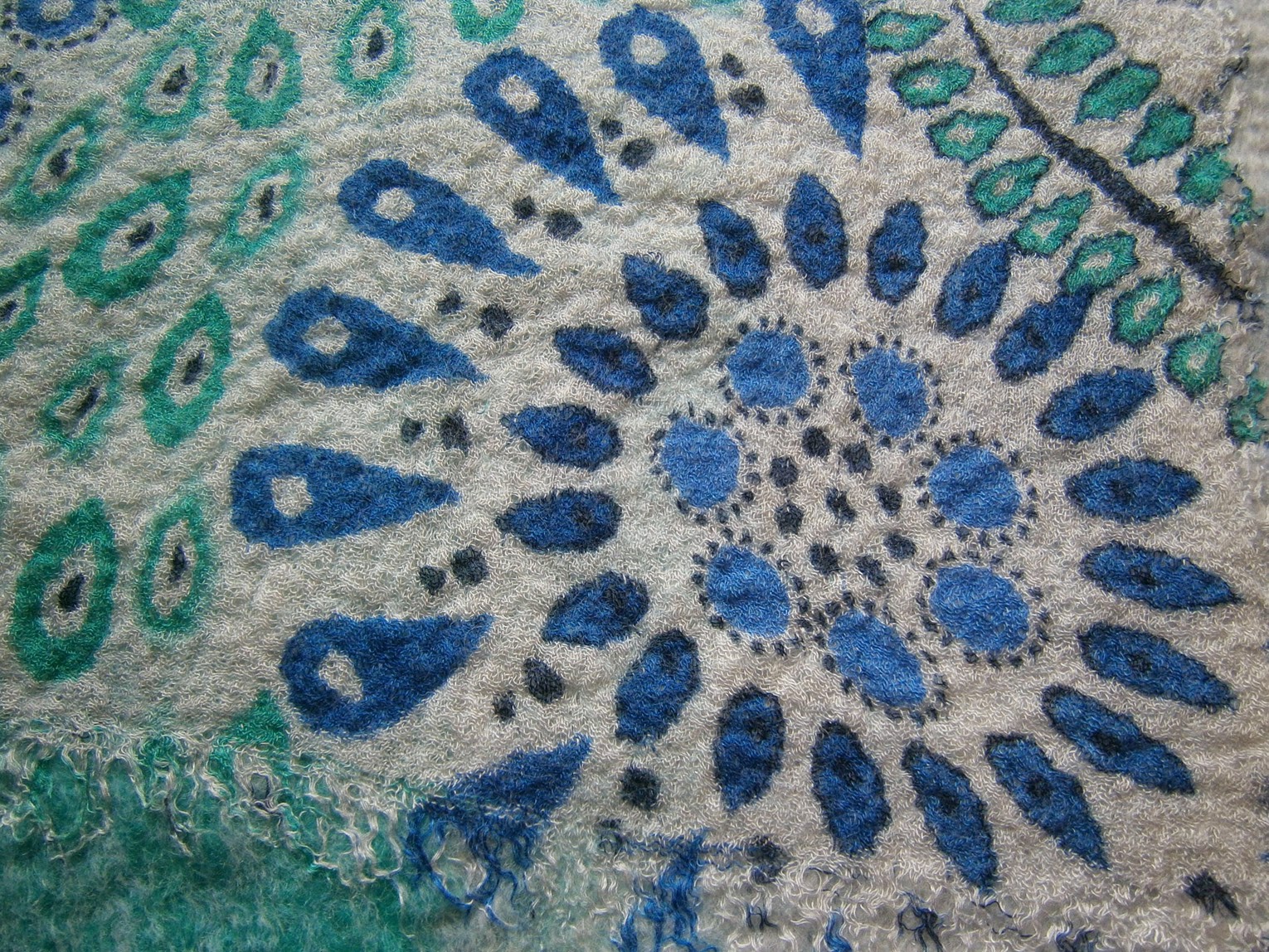
I decided to try and do a wet felted version of it. I did a couple of layers of Merino tops in a simplified palette of colours, then used some bamboo skewers to split the painting and felt piece into quarters as a guide for adding more detail for the 3rd layer.


I had pretty much all my colours of Merino out for this.


This is the finished layout:


All the wool put away and 'tidy' :)


I took it outside to felt it:


I had an audience:


I put it on the washing line to dry. I usually stand the painting up on its end (right end), and while I was felting, some of the wool must have gotten nudged and I started to neaten it up, but thought it would look quite cool and like it was dripping if I left the wavy edges. They neatened themselves up a bit while I was fulling though, but still looks pretty good.


Finished piece:


Detail:


Monday, 8 June 2015

Pencil Roving Mats

I recently got some Pencil Roving when I did a World of Wool order. I liked the look of it, but couldn't decide on which colour, so I decided to get a 500g bag of Pencil Roving waste. I expected more than 4 colours, but it still worked out cheaper. I wanted to see how well it worked layered, so I decided to make a 'woven' mat/coaster type thing. I started off with a 10 x 10 inch template:


Then I cut the pencil roving a bit smaller than the template, 10 strands of each colour:


I laid the strands across the template:


I then held the bottom of the strands down with a ruler and flipped back alternate ones:


I laid the horizontal strands across the columns and then flipped back the other strands:


I used a plastic knife to push the strands in to place.


This is how it looked when it was finished:


I didn't think it looked its best, so I took off a few of the strands at the ends:


I added a couple of layers of Merino tops, then felted it and fulled it quite firmly. It was about 7.5 x 7.5 inches afterwards:


I also made another mat with pencil roving, I used up some of the spare lengths left over from the other mat, and added rows and columns. This one ended up slightly wider as there wasn't as much roving going across as there was top to bottom:


I thought they turned out really well :)


*** If anyone is interested in the 3 week Wet Felting for Beginners Course, there is just over a week left for registration, the last day is Tuesday 16th June, you can find all the info here: http://feltingandfiberstudio.com/classes/wet-felting-for-beginners/

Friday, 15 May 2015

Nuno Samples and Stone Sheep

I can't remember the last time I got a chance to do some felting, but I got chance again the Sunday before last, and I'd had the pieces laid out for at least a week and half. Two of the pieces were nuno samples. I'd bought some scarves and wanted to see how the fabric felted. For both samples, I laid out two layers of Merino tops and laid the fabric on top. The first scarf I tried didn't have a label on it, it felt like a synthetic chiffon, slightly 'rough'. It felted quite nicely, though there were a couple of places along the edges where it didn't attach securely.


The nuno texture was really nice:


The next piece I tried was viscose, it was really soft. It looked like crepe after felting:


A close up:


A supermacro close up, I think I got the colours matched pretty well :)


Another piece I made was with Stone Sheep wool. I first tried this last month, probably the previous time I did some felting. I liked the way it felted and how fast it felted so thought it'd be really good for something I wanted to try out. I laid out a couple of layers of some carded Stone sheep wool, then added a big pile of fake Angora fibre in the centre. I covered it with a circular resist, covered the resist with some 'Silk Schappe' that I got from wollknoll (it seems like carded silk noil), then added another couple of layers of Stone sheep wool. I finished it off with some kapok fibre. When it was felted, I snipped a little hole to take the resist out and worked it until I got it how I wanted.


I thought the fake Angora might be a bit fluffier and looser than this, I mustn't have piled quite enough in!


You can see the Silk schappe from this angle:


Saturday, 9 May 2015

Online Classes

The Felting and Fiber Studio's next "Wet Felting for Beginners" online workshop will start on Friday June 19th. It’s a 3 week course developed to give absolute beginners a good foundation on which to develop their wet felting skills. Not only are there the expected ‘How to Felt’ instructions, but there are also simple exercises designed to show what happens when wool felts under different conditions so you can control the outcome. There is also lots of info on using different types of wool and animal fibres, tips for inexpensive tools, alternate techniques etc. For more info on the course, have a look here: http://feltingandfiberstudio.com/classes/wet-felting-for-beginners/ There is all the information you need, including what 'equipment' and supplies you'll need and there's also a link to a simplified supplies list.


If you'd like to sign up for the course, please use the Contact form at the bottom of the Class information page. There are some prices in different currencies listed there too. Don't forget to include your PayPal email address in the specified field. Once payment is received, you will receive an email with all the information you'll need.

Our first class was really successful, if you'd like to read testimonials from some of the students, please have a look on our main Online Classes information page: http://feltingandfiberstudio.com/classes/  You can also have a look at some of the work produced by students on the gallery page: http://feltingandfiberstudio.com/classes/wet-felting-for-beginners/wet-felting-for-beginners-student-gallery/

Please feel free to contact us if you have any questions, or if you are interested in teaching a course or workshop yourself, we have everything in place for you to host your own online workshop on a secure site.


Monday, 13 April 2015

Colour Challenge

On the Felting and Fiber Studio, we have Quarterly Challenges. This year is all about Colour. For the 2nd Quarter Challenge, Ann challenged us to use a photo to generate a colour palette to work with. I chose a digital painting of mine to play around with:


I started off using Photoshop. The first filter I used was Median, I wanted to get a simplified version of the painting:


I then used some other filters to get more defined areas of colour. This one was Mosaic, I set the cell size to 50:


And this was Mosaic with the cell size set to 200:


I used the Crystalise filter set to 200 for the cell size on this one, the colours are similar to the 200 Mosaic one, but because it follows the shape of the original more and isn't square, there is  more colour variation:


The last version I did using Photoshop was using the Gaussian Blur filter. I selected 5cm x 5cm squares, then blurred that section to one colour:


I uploaded the image to a site Ann recommended, Color Palette FX, and this was the result:


I also used one which had been tried on the Felting and Fiber forum, Moda Palette Builder. This was a bit different, it didn't reduce the picture to a few equalised colours, but you  choose which areas of the picture you want to pick out colours from to create a pallette:


I always enjoy messing around with colour and on Photoshop, so this was fun. If you're interested and want to join in the challenge and show us your results, come and join the forum or use the Contact Us form on the Studio Site, we're always interested in anything felt or fibre related and would be happy to do a blog post feature :)

Sunday, 5 April 2015

Karakul

I was hoping to get some time for felting yesterday, but I had vertigo and felt rotten so I'm posting some pieces I made a few weeks ago. I got two different Karakul batts from wollknoll, one is just Karakul and the other is a Karakul and Merino blend. Just be warned if you google Karakul, you'll probably get some pretty awful photos of dead lambs because their skin is used to make hats and coats because their wool is black and silky soft when they are born, and they don't often make it that far so there's quite a few photos of dead sheep too. This wool is sheared the usual way though. It is double coated and very wiry, it reminds me a lot of a Cairn Terrier my friend had when we were kids:


I used some dyed silvery flax with the Karakul, spreading it thinly across the top and bottom, and laid it  vertically in the centre:


It looked like it was just sitting on the surface:


The contrast of the 'dry' looking Karakul and shiny flax, made the flax look like it was still wet:


The Karakul and Merino looked and felted similarly, though less 'openly' or loosely and was a lighter shade:


Both of the batts had bits of VM in which looked like porridge oats or tiny cornflakes. A few of the batts I got had similar VM:


I used some crimped Viscose fibre with this:


This is some Viscose which wasn't teased apart much:


This is a patch where the Viscose was teased apart a lot and laid on quite thickly:


And this is where the teased out Viscose was laid quite sparsely:


Sunday, 29 March 2015

Dutch and Russian Wool

I got some 'Yellowish Dutch Wool' from wollknoll, 34 mic 'not suitable for felting', it said. It seemed to felt fine for me:


I don't know what breed it is, I'd guess Texel, maybe someone who's bought it knows? Here's a close up of a corner:


I thought I'd try a variety of fibres again, so the top row is a blend of black Viscose tops and Ingeo, the narrow band in the middle is Fake Angora, and the bottom is black Bamboo and White Bamboo blended.


Different angle:


This is a close up of the Viscose and Ingeo:


And close up of the fake Angora (it has a strange feel to it, and looks kind of waxy):


Another vaguely listed wool I bought was 'Russian-Camelhair'. I'm guessing from the way they describe things on wollknoll, that 'Camelhair' is the colour, it's more reddish though. And this is also 34 mic but 'This wool is especially suitable for felting'. Another guess is that this is Romanov wool. It seems to be double coated like a lot of the ones I ordered. I used Ramie fibre with this:


The circular parts are Ramie that I fluffed up then patted down into little discs:


This is a close up of Ramie just fluffed up and added:


The sun came out as I was taking this, I usually try not to take photos in the sun, but I liked this one:


Over on The Felting and Fiber Studio site, our challenges this year are all going to be based around colour. The first quarter challenge had us looking at the colour wheel, tints and shades and blending. I had some 'Hot Pink' Merino wool tops, quite a lot actually, so I used them with white Merino and black Merino to see what blends I would get. You can read the whole post here and see the batt I made.