Showing posts with label silk. Show all posts

Monday, 24 October 2016

Unexpected Results

I thought I'd make a big piece of nuno felt, with plans to make it into a book cover. I recently got a big bag of Botany Lap waste from World of Wool with some nice blues and purples slightly different to the ones I already had so I thought a patchwork of colours with a collage of silk pieces would work great. I noticed quite early on it didn't seem to be felting the 'usual' way, but put it down to starting on the back, which I don't usually do, but had wanted to make sure there were no thin edges, so I'd flipped it over. And I wondered if I'd overwet it a bit too. Then some bits of silk came right off, which did seem very odd, as I've been using bits of these same silk scarves for years. I thought that one of the 'waste' wool tops I'd used mustn't have been Merino, it did feel a bit 'rougher', but sometimes they can do if they're a bit old or some colours seem a bit drier too. It wasn't vastly different so I guessed it might be Corriedale. When it came to fulling, it all got really weird. I know different wool breeds and wool amounts, and using fabrics etc affects shrinkage, so when I make patchy and/or nuno pieces, I don't expect it to be as neat and 'square' as simpler pieces, but this was all over the place. This is the finished piece now it's dry:
 

When I'd flipped it over during the fulling, when the distortion became more pronounced, I suddenly went 'Aaah!' as I realised. This is the back:


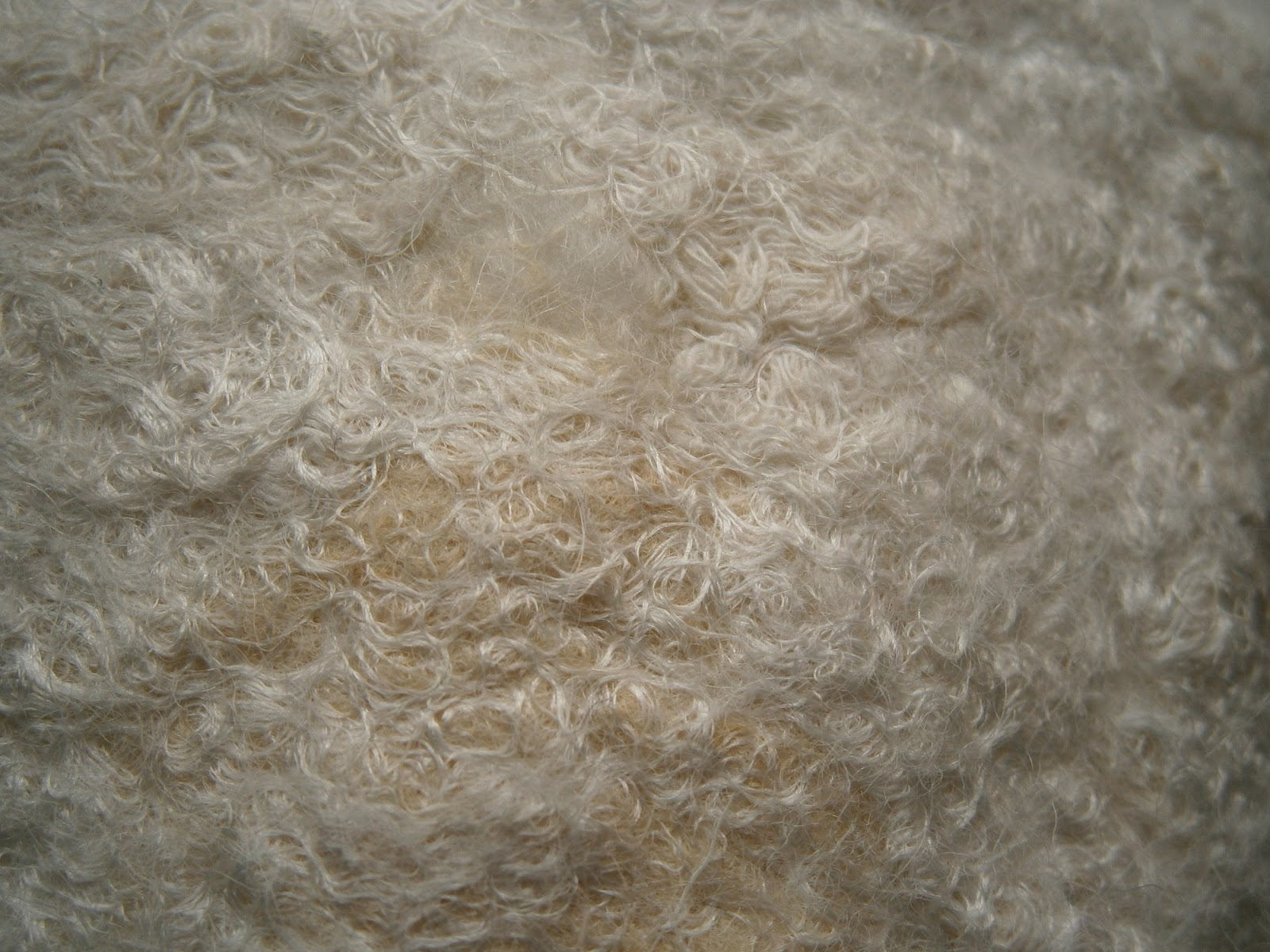
It seemed obvious then that not only was one of the 'waste' wool tops possibly not Merino (the mid blue), but the turquoisey one was probably not 100% Merino, either. It felt soft, but then some colours do seem softer, and it wasn't obvious looking at it that it was blended with anything. I did a burn test and it burnt the same as some Merino, but some of the close up photos I took made it look quite synthetic. It reminded me of the fake Angora fibre I have.


When I looked at the places where the silk hadn't attached fully and where it had come off altogther, it was where I'd used the soft lap waste tops both on top and underneath. This is one piece which really tried to hang on :


Where I'd used the two different types together, I did get an interesting texture on the Silk. This is the vertical purple/lilac strip on the right hand side:


And you can see in the photo of the whole piece how that silk strip changes about a quarter of the way down, with different wools. I think I'll keep all these together so I know to expect unusual results, maybe use them for experiments. The only real problem they caused was where the softer tops, possibly blends, were in two layers, and the silk had come off, the felt was cobwebby in those places. (not a great photo, but you get the idea!)


One piece which did turn out how I expected was a new coaster I made using some woven pencil roving waste which had been gathering dust for months (I flipped it over, just in case). I did almost use some Botany Lap Waste tops, but changed my mind at the last minute:


I think the colours and rippling give the illusion it's bumpier than it is. You can feel texture on the surface, but it's subtler than it looks:


Have you had any unexpected results or surprises using unknown wools or fibres?

Thursday, 2 July 2015

Natural Wools and Fibres

I've been re-organising my supplies lately, and one of the things I did was put my dyed silk products into one box, and my natural undyed silk supplies in another. While I was doing this I had an idea to make a silky cocoon type pod. I had a look on google images and liked the look of ones which were more fibrey, 'scruffy' looking. So I started by really piling the silk on to my resist. I added a couple of bunched up silk hankies, a silk hankie I'd drafted into roving, silk throwster's waste, schappe silk from wollknoll, different types of silk noil, some coccon strippings. I can't find my undyed silk carrier rods, but I did find a little bag of 'fluff' I'd carded from silk carrier rod scraps a few years ago, so I put that on too. I did a layer of 18.5 Mic  Merino on top of the silk, then on one side I lay lengths of white pencil roving. I used 23 Mic Merino for the second layer, and then 2 layers of English 56s. I do like the way it turned out, but I didn't expect it to be so 'neat'!


I thought with all the silk I'd piled on it'd be a lot more fibrey, but it does have nice texture and structure and there's a lot of different shades.


This is a closer look at some texture:


And this is some of the throwster's waste:


I wondered if some of the texture and features would show up more with a light inside, so I used a bit of sewing thread to attach it to a ceiling light to see:


You can definitely see more, and here you can see the ridges from the pencil roving better, I think it looks quite creepy with the light inside:


Another piece I've made recently is this wall hanging. I laid it out about a week or so before I got time to felt it, and I think it ended up being 'upside down'. I wrote down the wools and fibres I used as I laid it out, but think I forgot a few as I kept adding locks here and there! Also, I added a few locks to the bottom just before I felted it, but I'm certain that was originally the top:


I added some pieces of handspun yarn I'd made mostly from bits left over from carding, I spun them quite thickly, and didn't do anything with them after wards, just wound them onto card. This one is on the row of white Chubut, a 'new' to me wool I got from wollknoll, which felts so nicely and looks really nice too.


These are some cotton fibres: cotton top, cotton fibre and cotton nepps on carded Portuguese Merino, with some soy staple and carded Gotland.


If you are interested in trying more fibres in wet felting work, I recently wrote an e-book guide to using them. It features 20 commonly available natural fibres. Have a look at the info page :)

Tuesday, 30 December 2014

Dyed Wool and Fibres

A few weeks ago, I decided to dye some wool and fibres. I used up quite a lot of my dyed texturey wools when making batts recently, so I wanted to to restock those and thought I'd do a few fibres while i was making a mess. I ended up having to do it over three days, and it made a right mess, but it was worth it in the end :) I bought some white Kent Romney lambswool to try for adding texture, I had a little bit of scoured Falkland fleece left over too so added that:


I've bought commercially dyed silk noil before, but it really isn't good compared to the small amount I dyed once, so I thought I'd give that another go:


I also dyed some Tussah Silk tops - a good tip for anyone wanting to dye small amounts of fibre tops is to separate the amount you want to dye while the tops are dry, and soak them separately, it isn't easy when they're wet!


I used the same shades to dye some Soy top as I had on the Silk, and though they look similar, they soy definitely looks a lot shinier:


Neither of them come close to the colours and shine of the Milk though, but I did do these on a separate day and they weren't the same lot of dyes:


At the last minute I decided I wanted to dye some Gotland, Teeswater and Wensleydale locks. These were all raw, unwashed, so the night before my last lot of dyeing I gave some locks a shampoo and rinse. This is the Gotland:


I do have some more stuff waiting to be photographed, some Bluefaced Leicester wool and locks, soy staple fibre and carded lambswool, I'll add those to my 'supplies' album on flickr when I get good enough light. The last one I've got for now is Trilobal Nylon (sometimes labelled as 'Firestar' and sold at exorbitant prices) cheap nylon tops. The photo hasn't really picked it up, but it has a lot of sparkle and these dyed really well:


 If anyone is interested in dyeing smallish amounts of fibres, I did a small tutorial on it a while ago: http://feltingandfiberstudio.files.wordpress.com/2011/12/direct-dyeing1.pdf  luckily this time, I had my fold out table for a larger work area!  I used acid dyes which are good for protein fibres (animal fibres, soy, milk, silk, and nylon too as it is a synthetic version of silk). I have tried it on bamboo before too and got some nice, pale results, so it's worth trying a sample or two :)   

I did a 'Year End Round Up' post on the Felting and Fiber Studio today, having a look back over things I've made this past year. What did you enjoy making this year? Come and add to our discussion on the forum.


Tuesday, 28 October 2014

Recent Work

I mentioned recently that I'm doing a Craft Fair soon. It's this coming Sunday at Victoria Baths on Hathersage Road in Manchester. They also do guided tours that day, so if you're interested, have a look at their website.
In my post last time, I showed a faintly plaid felt piece which I'd started to make into a diary cover. Here is the finished cover:


I also mentioned a piece of silk I got for £3 a metre. I did manage to use it on a felt piece, but i haven't made it into a cover yet. It looked a bit nicer and brighter just before the final fulling, but I wanted to make sure it would stand up to years of handling:


I don't know if you remember a couple of pictures I posted as part of the Felting and Fiber Studio site's Jackson Pollock challenge from a bag I was working on, well, I never did get around to finishing the bag, and when I saw it recently, I thought I could cut it up and turn it into a nice sturdy diary cover. So, I did :)  This is the front:


And, this is the back:


I always forget just how long it takes to do those covers! Also, because I didn't have any coloured threads which I thought would be just right, I 'blended' my own. I took a strand each of Red, Orange, Yellow, Green, Blue and Violet embroidery floss and made a 6 strand rainbow. I had to do that for each part I stitched, and I was starting to regret it by the end :) 

One of the things I wondered after the last fair was whether it was obvious that my stuff was actually handmade felt made from real wool. A lot of my stuff is well felted or nuno felt, so to anyone who doesn't know felt, it could just be commercial fabric I've bought. So I thought I would make some obviously wool natural pieces for book covers. They are made from lots of different breeds of wool and embellished with locks, some mohair boucle from Marilyn, some silk noil, and viscose and bamboo. This one has the most added embellishments:


I did actually use the same size template for these pieces, but with all the different wools and embellishments there was different shrinkage. For this piece, I tried to stick to wools which were more similar: Merino, Bluefaced Leicester, Finn and Corriedale, and there are less embellishments:


If I get chance before the fair, I'll upload the finished covers to ipernity or the forum.http://feltandfiberstudio.proboards.com/

Thursday, 5 June 2014

Natural Wools and Fibres

You might have seen my post on the Felting and Fiber Forum last week about a wall hanging I made using natural coloured wool tops from many different wool breeds and some different embellishment fibres. Someone usually asks, so this time I've measured :) It's 30 inches long and 10 inches wide.


This is the bottom end, some of the wools and fibres are: Bluefaced Leicester tops and noil, Humbug Jacob, Black Jacob tops and noil, Lincoln, Gotland, flax, hemp, soy top, milk top and viscose.


This is a close up of the Soy top and Lincoln tops.


And this is Viscose tops on Zwartble with some Ingeo to the side.


As much as I love colours of dyed Merino or the textures of a nuno felted silk or shiny organza, I really love the variation of colours and textures you get with different combinations of natural wools and embellishment fibres. For as long as I've had natural wool tops and embellishment fibres I've been making various experimental pieces of felt with them, some just flat wet-felted, some combined with other techniques for a variety of surface designs or sculptural effects. When I got my recent World of Wool order and a few more breeds to try, I thought I'd also start to make a variety of small panels with the intention of maybe combining them into one large wall hanging some day. This is a panel I made using Manx Loaghtan wool tops and Bamboo staple fibre:


This is an angled photo of the panel I made with Grey Herdick wool tops and Hemp fibre:


I'll post more photos of other panels that I make with different wools and fibres. This last piece is something I made alongside the top stripey piece:


The Winner of the Heidi Feathers giveaway has been announced on the Felting and Fiber Studio site today, so if you entered, go and check if you won!

Sunday, 10 March 2013

A Guide To The Felting And Fiber Studio Site

We’ve had a lot of new visitors to the Studio site recently, and lots of new members on the forum, so I thought it might be time to do a reminder about everything we have to offer here on the Studio site. Before we started the blog just over a year ago, the four of us spent about 6 weeks working on the site, filling it with as much info as we could. We wanted to build the site into a valuable ‘One-Stop’ resource for anyone interested in felting and fibre. The ‘About Us’ page tells you a little bit about why we started the Studio site, and there are sub pages for each of us with some info about ourselves and our interests.


In the Felting section there’s a short introduction about the many different kinds of felting. The main pages for Machine, Needle, Nuno and Wet felting all have more in-depth information, and each has a gallery page with many different examples of that particular type of felting.


Mixed media simply means artwork that is made with more than one medium, but for the purpose of the site we use it to mean artwork made mainly with felt or fabric combined with other materials. This section features pages about Beads and Beading, Hand Stitching, Machine Stitching and Surface Design. Each page’s gallery features many examples of artwork.


 The Fibers section is packed full of information about wool and other animal fibres. The main Fibers page explains some of the different terms that are used to describe wool in its various stages of processing. The Wool and Other Animal Fibers page has a lot of information about wool, animal fibres from animals such as Alpaca, Angora goat, Llama and Camel. There is also an explanation of the Micron and Bradford Count systems of measuring a fibre’s fineness or coarseness; and a PDF guide to the most common sheep breeds and their Bradford and Micron numbers. The gallery page features photos of different animal fibres. Preparing Fibers has a guide to processing your own wool, from washing a raw fleece to carding it into fluffy batts ready for felting or spinning. There is a photo set and detailed description.


The Other Fibers section has lots of information about the non animal fibres we commonly use in felting, such as silk and organza fabrics; fibre prepared into tops like bamboo, banana, viscose, and the more unusual fibres like crimped nylon, plastic and Angelina fibres.

The Silk page shows the many different silk products available, for example, silk carrier rods, silk hankies and silk throwster’s waste and the gallery page features many uses of these. The Man-made fibers page and its gallery have examples of fibres and their uses including commercial art yarns and  some nuno felt examples with synthetic fabrics. The Plant Based Fibers page has many examples of these gorgeous luxurious fibres and felted pieces using them.


The Tutorials section is another area with a wealth of information. There are free Dyeing, Felting, Fiber preparation and Mixed media tutorials all written by one of us, including a video on how to make your own roving using a diz, PDFs on Degumming silk and dyeing it; Stitching on felt, making mixed media wall art, using a sander for wet-felting, a beginners guide to using a drop spindle and dyeing with food colouring.


And if you can’t find what you want there, there are also links to outside sites in the Links/Resources section, including rosiepink’s free felting tutorials and their fantastic e-book showing how to make amazing felt artwork and Ruth’s book The Complete Photo Guide To Felting.

We've been working on upgrading the site over the last week or so, and have added new photos to the different pages and to the galleries. We also added a new Fabrics page. This is in the 'Other Fibers' section and also has its own gallery.


So, make yourself comfortable and come over and have a look around the site.  We’re always happy to read comments and listen to suggestions for adding more to the site, or to requests for articles or tutorials. Maybe you are a fibre artist with an interesting skill that would make a great feature or you’d like us to link to a tutorial, if you have anything felt or fibre related you want to tell us about, we’d love to hear about it :)

Sunday, 24 February 2013

Giveaway—Beyond Nuno PDF e-book

As a big Thank You for all the support I've had since I started felting and blogging, I'm giving away a copy of my new PDF e-book called Beyond Nuno on The Felting and Fiber Studio Site. It's all about using different fabrics in wet felting, why and how they felt the way they do, how different effects are achieved etc. I hope to show that there's more to nuno felting than just ruffled silk scarves and that it is possible to control the outcome of nuno felting. For more details you can read the blurb on Craftsy or the e-book page of this blog.

You don't need to do anything special to enter, just leave a comment on the Giveaway post post. If you'd like to spread the word through your blog or facebook etc, it would be very much appreciated but it isn't a requirement. I will randomly draw the winner 8 days from now on 4th March 2013, so please check back to the studio site to see if you've won and leave a comment on the announcement post so I can contact you with the download information.

Good Luck! :)

Wednesday, 20 February 2013

My new e-book

It seems like it's been forever in the making, and months since it was actually completed, but the e-book I have been working on is finally available to buy!


Beyond Nuno explores the use of fabrics in the art of making wool felt by the traditional wet-felting method. It features the fabrics most commonly used in felting--silk, organza and the open-weave cottons scrim, cheesecloth and muslin. There are also additional sections on synthetic fabrics and other lightweight cottons.
The book shows how these fabrics work with wool to create certain effects and how they can be used effectively and manipulated with different techniques.

Unlike project based books, the content focuses on how and why these fabrics work the way they do to provide the info you need for more control over the outcome of your nuno felting; how to achieve the effects you desire, and provide a basis for continued experimentation instead of feeling that felting is all just ‘guess-work’.
There are 190 full-colour, high quality photos in the book. Every photo is taken carefully to clearly demonstrate the information in the text. There are also many supermacro shots to show high definition examples of wool fibres and fabric weave to further illustrate the information, and because this is an e-book, all the photos can be enlarged up to 300% for even more detail without losing any quality.


Although nuno felting is seen as an ‘advanced skill’ in felting, I think anyone who has tried felting will find this book very easy to understand and follow. In the introduction, there’s a small step by step demonstration of how I felt, and I’ve included a small glossary at the end to help make things clear.

Hopefully before too long it'll be available to buy straight from my blog, but for now it is available from Craftsy.  http://www.craftsy.com/pattern/felting/beyond-nuno/45714

I really enjoyed making the book and it was hard to stop, there was always something else that was 'vital' and just had to be included!

 I had lots of help and must say some thank-yous. Thank you to my girlfriend for putting up with many mini-meltdowns and for giving me a unique perspective which I think has really helped to make this book different to anything else around. A massive Thank You to Lyn from rosiepink. Lyn has published an excellent e-book, a step by step guide to Creating Felt Artwork, and as well as reading and re-reading endless drafts of my book, gave me lots of invaluable advice about the whole publishing and selling side of things. Thanks, Lyn :)
I must also thank Karen and Ruth. Sorry for all the ranting and moaning, Kaz, and thanks so much for reading through and making sure it was clear and simple. Thank you so much for your thorough proof reading, Ruth, all your suggestions and invaluable insight. Ruth is the author of the fantastic Complete Photo Guide To Felting. Thanks to Pam from the forum for all your help with the Introduction, getting that right really helped make the rest of the book clear. And Thank You to everyone who reads my blog, leaves such nice comments here, on flickr on The Felting and Fiber Studio site and everyone at the Felting and Fiber Forum :)

*** It's now available to download straight from the blog, just click the photo on the top right which says 'Instant Download' underneath, or go to the e-books page.

Saturday, 22 September 2012

Catch Up

Sorry for not posting anything for a while. I think I've just had too many things going on at once, and I don't know about you, but when I've got so many things I need to do that I don't know where to start, I usually end up putting them off longer! One of the main things I've been working on is getting through my huge pile of WIPs.


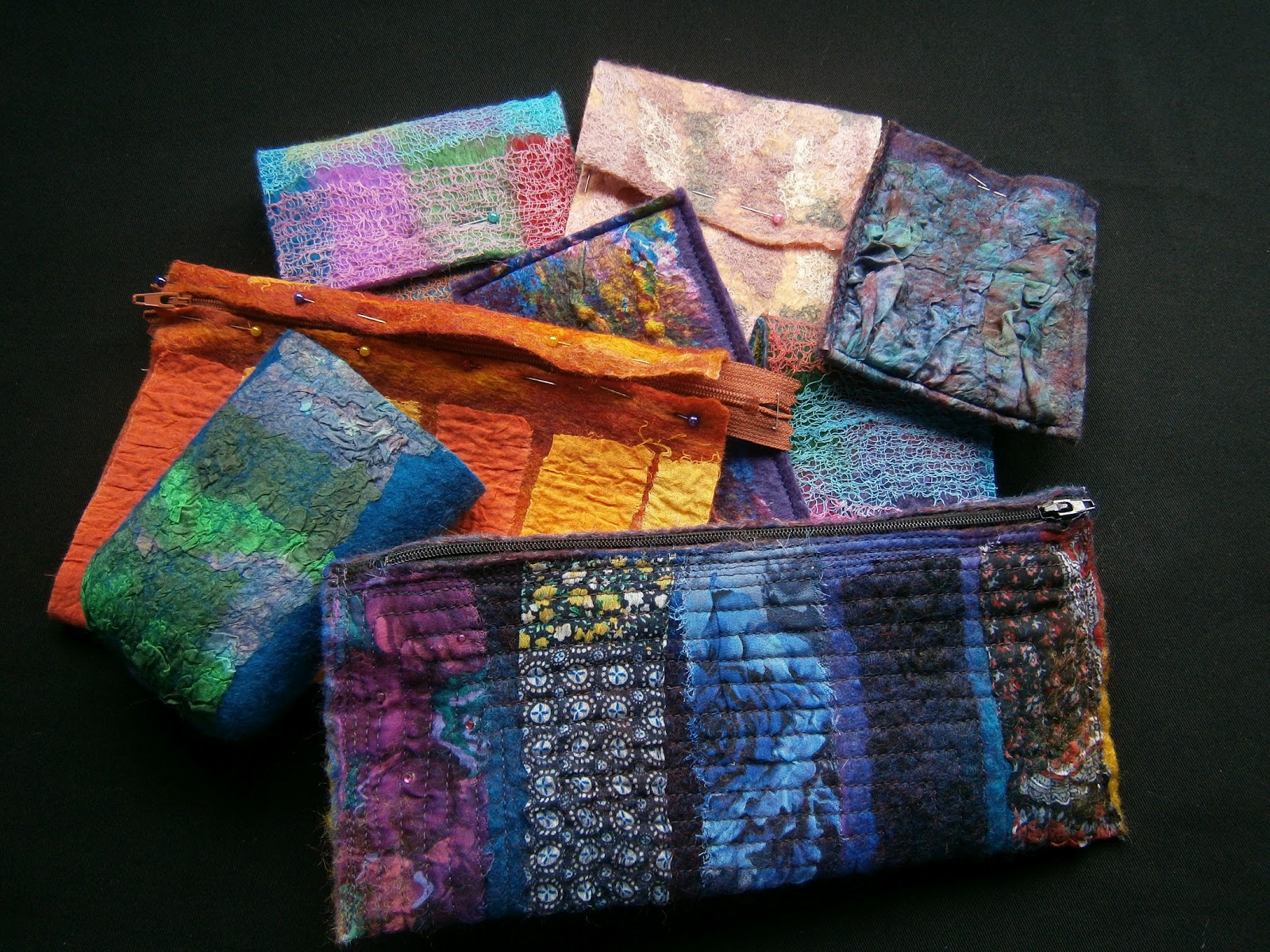
As part of my other fabrics and fibres project, I had lots of unfinished pieces waiting to be made into things...unfinished camera pouches, pencil cases, iPod cases, mirror cases, purses, glasses cases... not to mention lots of pieces of felt waiting to be cut and pinned and sewn to add to the pile :)

They are mostly finished now, and one of the biggest tasks was photographing them all. For a while I just had 2 cloths for photographing-a black piece and some natural calico, but after struggling to get a few photos right, my girlfriend suggested using neutral colours like a brown or grey, so it ended up being a mammoth task taking photographs of about 30 felt pieces on 4 different backgrounds, not to mention the fun of going through and deleting all but the best. At least now that Summer is over, the light is better and getting good shots is far easier :)

I even had time to make some felt just for fun recently, which was really nice. I probably went a bit over the top with all the different fibres I blended with the wool and all the different fabric and fibre embellishments I piled on the top, but it was nice to make something that wasn't controlled or being made with anything in mind for a change :)


Have you been working on anything just for fun lately?